This post contains affiliate links.
By Olami, AbroadPilot · Reviewed September 2026
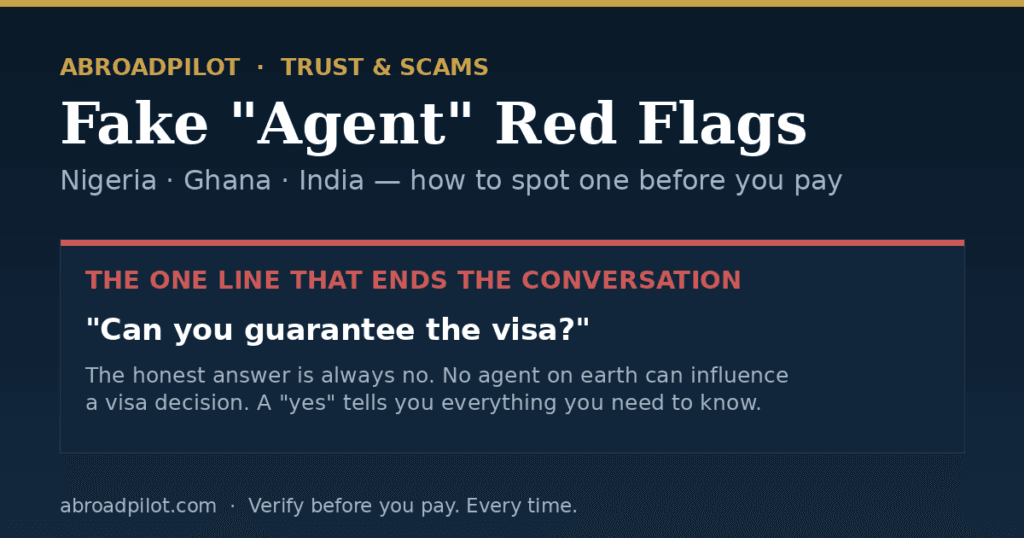
Quick summary: The single most useful sentence in this entire guide is a question you should ask every agent, on the first day, before you hand over a single naira, cedi or rupee: “Can you guarantee the visa?” The honest answer is always no. No agent on earth — however well-connected, however expensive, however many photos of smiling graduates are on their wall — can influence a visa officer’s decision. Anyone who says yes has told you everything you need to know. This guide covers the rest of the red flags, the verification checks that actually work, and what to do if you have already paid.
Why You Specifically Are the Target
Visa fraud is not random. It concentrates precisely where demand is highest and fear of refusal is greatest — Nigeria, Ghana, Kenya, India, Pakistan, Bangladesh. Scammers are not stupid. They know that a Nigerian student facing a high US refusal rate, or an Indian family that has already sold land to fund a degree, is under enormous pressure. Pressure is the product they sell against.
And they operate at scale: Facebook and Google ads, cloned websites, WhatsApp broadcast lists, TikTok testimonials, an office with a nice sign, and a queue of other hopeful applicants in the waiting room to make it all look normal.
The consequences are not merely financial. Students have been deported because an agent submitted forged financial documents on their behalf — without telling them. Students have arrived at a university that had never heard of them. Students have been permanently banned from a country over a document they never saw. The agent is gone. The ban is yours, and it follows you for years.
You are legally responsible for every document submitted in your name — including the ones an agent filled in without showing you. “My agent did it” is not a defence anywhere in the world.
The Red Flags, Ranked by How Dangerous They Are
Tier 1: Walk Out Immediately
- “Guaranteed visa” / “100% success rate” / “We have someone at the embassy.” This is the whole scam in one sentence. Nobody has someone at the embassy. Nobody can guarantee a visa. An agent claiming embassy connections is either lying to you or attempting bribery — and both end with you carrying the consequences.
- They ask to fill your forms without showing you. Never sign a blank form. Never let anyone submit an application you have not read line by line. This is precisely how forged bank statements end up in your file and how students end up deported.
- They offer to “arrange” bank statements, sponsor letters, or work experience. This is document fraud. It is a criminal offence in your country and in the destination country, and detection means a multi-year ban. Any agent who casually offers this is telling you they do this routinely — which means they will do it to you.
- They keep your passport. An agent has no legitimate reason to hold your passport for weeks. This is leverage, and it is used to extract more money.
- Payment to a personal account. Cash in an envelope, a personal bank account, a personal mobile money number. A legitimate business receives money as a business, and issues a receipt.
- “Pay today, the offer closes tonight.” Manufactured urgency exists to stop you thinking. Every real deadline can be verified with the university directly.
Tier 2: Serious Warning Signs
- They will not put the fee in writing. A real service gives you one clear fee, in writing, with terms, before you pay. Vague or shifting numbers are a red flag every time.
- They block you from contacting the university directly. Fake agents control information flow because the truth destroys them. You are always entitled to email the university’s international office yourself.
- They charge for things that are free. Many university applications are free or low-cost. Some agents are paid a commission by the university and charge you a large fee for the same work.
- The university is one you have never heard of, and they are pushing it hard. Agents receive commission per enrolment. A hard push toward one specific institution usually means it pays the best commission — not that it is the best fit for you.
- No verifiable office, no registration number, no company details. A WhatsApp number and an Instagram page is not a company.
- Full tuition demanded upfront, before a visa. Universities take a deposit. Demands for full tuition before you have any visa outcome is a classic pattern.
- All the testimonials are on their own page. Of course they are positive. Search their name alongside “scam” and “complaint” on independent forums instead.
Country-Specific: What to Check and Where
Nigeria
- Verify the company exists. Check registration with the Corporate Affairs Commission (CAC). An agency without a CAC number is not a company — it is a person with an office.
- The “Japa” pressure is the vulnerability. Scammers weaponise the collective urgency to leave. Every offer framed as an escape route deserves more scepticism, not less.
- Beware the “work and study” and “caregiver visa” packages. These are heavily advertised on Nigerian Facebook and TikTok, and are frequently either outright fraud or a legitimate-looking route that does not exist as described.
- A genuine employer never charges you for a job. If a foreign job offer requires you to pay for the work permit, it is a scam. Real sponsors pay for sponsorship.
- If defrauded: report to the EFCC and to your bank immediately, and to the Nigeria Police. Speed matters enormously for any chance of recovery.
Ghana
- Check registration with the Registrar-General’s Department. Ask for the certificate. Verify it, do not just look at it.
- Mobile money is the main fraud channel. Any payment to a personal MoMo number is unrecoverable and untraceable to a business. Insist on a business account and a receipt.
- Verify the school is accredited both in the destination country and, where relevant, that the qualification will actually be recognised on return.
- If defrauded: report to the CID, to your bank, and to your mobile money provider immediately — reversal windows are short.
India
- Check the company registration on the Ministry of Corporate Affairs (MCA) portal, and ask for the GST number. Legitimate consultancies have both.
- Verify the university on the official portal for the destination — UCAS or the UK government register for the UK, SEVIS for the US, the DLI list for Canada. If the institution is not listed, walk away.
- For MBBS abroad, verify NMC recognition before anything else. The approved list of foreign medical colleges changes, and institutions get derecognised. An agent pushing a college that is not on the current NMC list is selling you a degree you cannot practise with.
- Any agent offering MBBS admission without NEET is committing fraud. No exceptions.
- Beware fake university “branch campuses.” Indian missions abroad have issued alerts about non-existent branches of real, reputable universities — students collectively lost crores to one such scheme. If a famous university has supposedly opened a campus you cannot find on its own official website, it has not.
- For visas, use only the official portals. Lookalike domains and paid search ads are the primary trap. If you reached the visa site through an advertisement, you are probably on the wrong site.
The Five Checks That Actually Work
You do not need to become an investigator. You need to do five things, in order, before any money moves.
| # | The check | How to do it |
|---|---|---|
| 1 | Ask the guarantee question | “Can you guarantee the visa?” A yes ends the relationship. Immediately. |
| 2 | Verify the company legally exists | CAC (Nigeria), Registrar-General (Ghana), MCA + GST (India). Get the number and check it yourself on the official register. |
| 3 | Verify the university independently | Go to the university’s own official website — not a link the agent sent you — and email the international office directly. Ask if your admission exists. |
| 4 | Get the fee in writing | One number, itemised, with a refund policy. Compare it against the official fees on the embassy and university sites. Anything inflated far beyond the real cost is the scam. |
| 5 | Pay a business, and keep the receipt | Never a personal account. Never cash without a receipt. Keep every transfer confirmation and every chat. |
Note that check 3 is the one that kills almost every scam outright, and it is the one people skip. Email the university yourself. It takes four minutes. Fake admission letters look completely convincing — letterhead, stamp, signature, reference number. The only reliable way to know an offer is real is to ask the institution that supposedly issued it.
“But My Agent Was Referred by Family”
This is the objection that gets people hurt, so it deserves a direct answer.
A referral from your uncle, your church, or a friend of a friend tells you that someone else’s process went fine. It does not tell you the agent is registered, that they are not committing document fraud, or that they will still be in business in six months. Many agents run legitimately for years and then, when business turns, take deposits and disappear.
The verification checks cost nothing and take an afternoon. Run them on the agent your uncle recommended too. A genuinely legitimate agent will not be offended — they deal with these questions constantly and will hand you the registration number without blinking. Watch the reaction to being asked. It is more informative than the answer.
If You Have Already Paid
Move quickly. Recovery odds fall sharply with time.
- Stop all further payments now. There will be another fee. There is always another fee — a “clearance charge,” an “embassy processing levy,” something. More money will never release a visa that does not exist.
- Screenshot everything before they delete it. Every WhatsApp message, receipt, account number, business card, website page, and social media profile. Scammers vanish, and they take the evidence with them.
- Call your bank immediately and ask about a reversal or chargeback. For mobile money in Ghana and Kenya, contact the provider the same day.
- Report it. Nigeria: EFCC and the Police. Ghana: CID and your bank. India: the Cyber Crime portal and local police.
- If a visa application was already submitted in your name, get proper advice urgently. If forged documents were filed without your knowledge, you need to understand your position before you touch another application.
- Tell people. Post it in the student groups. Name the operation. The reason these scams work is that shame keeps victims silent, and silence keeps the next student uninformed.
The Bottom Line
You do not actually need an agent. Millions of students apply to universities and file visa applications entirely on their own. A good agent saves you time and knows the paperwork; they do not have a secret channel, they cannot make a weak application strong, and they cannot influence an officer’s decision.
So the test is simple. An honest agent sells you their time. A fake agent sells you certainty. Certainty does not exist in this process, and the moment someone offers it to you, you are being sold something that cannot be delivered — at a price you will keep paying long after they have gone.
Ask the guarantee question. Verify the company. Email the university yourself. Then, and only then, pay.
Have you encountered a fake agent or lost money to one? Sharing what happened may be the thing that stops the next student. You can submit your story here — anonymously if you prefer.

Olami is the founder and lead writer at AbroadPilot. He started the site after going through the visa process himself — a German student visa in 2019 and a Canadian work permit in 2023 — and learning first-hand how confusing official immigration language can be, how often rules change, and how easy it is to lose money to bad advice. He spent three years as an international education and travel consultant, helping people source and verify the information that landed their visas and planned their trips. Every guide on AbroadPilot is built from official sources — embassy pages, government immigration portals, and .gov fee schedules — and reviewed as requirements change. AbroadPilot does not sell visas or applications; it is a free resource to help readers apply with confidence.