This post contains affiliate links.
By Olami, AbroadPilot · Reviewed September 2026
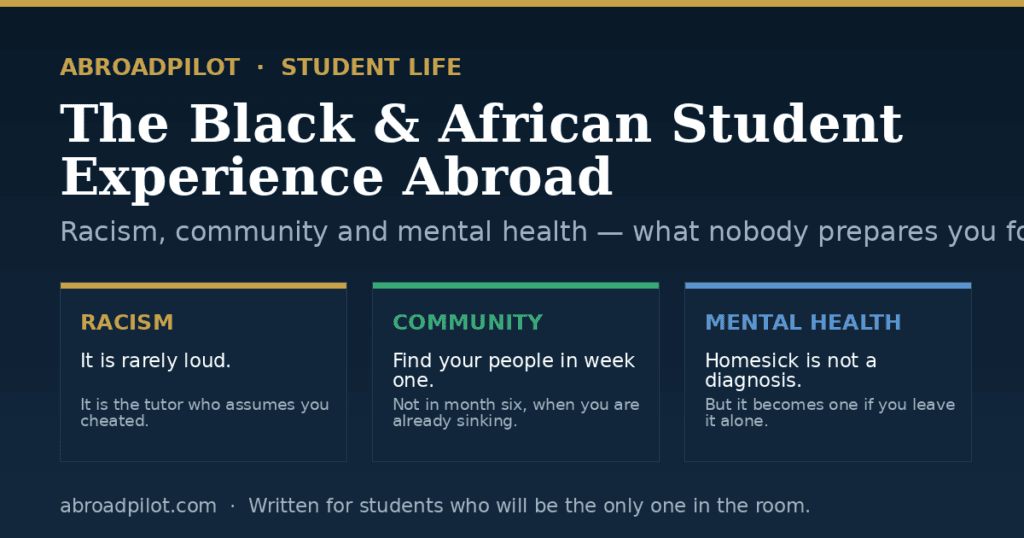
Quick summary: Nobody sits you down before you fly and tells you that you are about to become a minority for the first time in your life. Your agent will not mention it. Your university brochure will show you a smiling Black student on a lawn and say nothing else. This guide covers what actually happens — the shape racism usually takes on campus, how to build community before you need it, and how to protect your mental health when the loneliness arrives. It is written for Nigerian, Ghanaian, Kenyan and other African students, and for Black students generally, heading to the UK, Canada, the US, Ireland and Europe.
The Thing Nobody Says Out Loud
If you grew up in Lagos, Accra, Nairobi or Kampala, you have never been a minority. Your race has never been the first fact about you in a room. Your accent has never been a thing people ask you to repeat “one more time, sorry.” Your name has never been a small problem that other people sigh about.
Then you land, and within a fortnight you notice that you are counting. Counting how many people in the lecture theatre look like you. Usually the answer is a number you can reach without effort.
That shift — from majority to minority, overnight, at nineteen or twenty-four, eight thousand kilometres from everyone who has ever known you — is the single biggest unadvertised feature of studying abroad. It is not a reason not to go. Tens of thousands of African students go every year and build extraordinary lives. But going in prepared for it, instead of being ambushed by it in week three, changes everything about how the first year lands.
What Racism Abroad Actually Looks Like
Most students brace for the wrong thing. They brace for slurs and violence — the dramatic, unmistakable kind. That does happen, and we will get to it. But it is not what most students actually encounter, and bracing only for that leaves you defenceless against the version you will meet far more often.
The common version is quiet, deniable, and cumulative. It looks like this:
- The academic suspicion. You submit strong work and the tutor asks, more carefully than they asked anyone else, whether it is really yours. Research in the UK has repeatedly documented a substantial awarding gap — Black students receive first-class degrees at markedly lower rates than white students with comparable entry qualifications. That gap is not about ability. It is about how work gets read.
- The accent tax. Being asked to repeat yourself constantly. Being spoken to slowly. Being complimented on your English — which is your first language, and which you have written exams in since you were six.
- The group-work drift. Being the last one picked for a project group. Every time. Nobody says why. Nobody has to.
- The housing wall. The room that is available on the phone and mysteriously gone when you show up. This is one of the most consistently reported experiences among African students in the UK, Ireland and Canada.
- The housemate problem. Comments in shared accommodation, and then a reporting process that goes nowhere. Studies of Black students in the UK have found exactly this — that incidents get reported and the disciplinary procedures leave students feeling no safer afterwards.
- The one-Black-person job. Being asked to speak for an entire continent in a seminar. Being the diversity photo. Being consulted about “the African perspective” as though there is one.
Each of these is small enough that raising it makes you look oversensitive. That is precisely what makes them effective, and what makes them wear you down. The damage is not any single incident. It is the accumulation, and the exhausting internal work of asking, every time, was that racism, or am I imagining it?
Say this to yourself now, before you go, so that you have it ready: you are not imagining it. You do not need to build a legal case before you are allowed to feel it. And you do not have to decide whether every single incident was racism in order to notice that you are exhausted.
The Loud Version
It exists. Street harassment, slurs from cars, hostility on public transport late at night, occasionally violence. It varies enormously by neighbourhood — often far more between two areas of the same city than between two countries. It tends to be worse in places with little diversity and a local grievance narrative, and it spikes around elections and immigration news cycles.
What to actually do:
- Know the reporting route before you need it. In the UK, hate crime can be reported to the police or through True Vision online without going to a station. In Canada, most forces have hate crime units. Your university will also have a reporting mechanism — find it in week one, not on the night you need it.
- Report anyway, even when you expect nothing. Not because the process will necessarily satisfy you — often it will not. But because the record matters, both for your own case and because unreported incidents are used as evidence that nothing is happening.
- Tell someone the same night. Do not carry it alone until the weekend. This is the mechanism by which one bad evening becomes three bad months.
- Do not get talked out of your own memory. The most common response you will get is a well-meaning person explaining why it probably was not what you think it was. You were there. They were not.
Community: Build It in Week One, Not Month Six
Here is the mistake almost every student makes, and it is completely understandable. You arrive determined to integrate. You have been told, sometimes by your own family, not to “only mix with Nigerians.” So you avoid the African society, you avoid the church or the mosque, you push yourself into rooms where you are the only one — and you tell yourself this is the mature, ambitious way to do it.
Then February arrives. It is dark at four in the afternoon, you have not been touched by another human being in two months, your family thinks you are thriving because that is what you tell them on the phone, and you cannot remember the last time you laughed properly.
Community is not the opposite of integration. Community is the thing that makes integration survivable. People with a stable base integrate better, not worse — because they are not doing it from a position of desperation.
Find your people early, while you are still functional enough to go looking. It is far harder to walk into a room full of strangers once the isolation has already set in.
Where to look, in rough order of how quickly they pay off:
- The African / Caribbean / Nigerian / Ghanaian student society. Almost every university with meaningful African enrolment has one. Go to the first event even if you feel too old, too shy, or too serious for it.
- The Black students’ officer or BME network in the students’ union. They know which staff members are actually helpful and which departments have a reputation. This is institutional knowledge you cannot get anywhere else.
- Church, mosque, or your faith community. For many African students this is the single most load-bearing structure of the first year — a place where you are known, fed, and expected on Sunday. Do not underestimate it, even if you were not especially devout at home.
- The diaspora, not just the students. The barber who cuts Black hair. The African grocery. The auntie who runs the shop. These people have been where you are, and they will feed you.
- Your course. Yes — also build friendships with people who look nothing like you. Both things are true at once. You need both.
A specific, practical instruction: before you fly, search “[your university] African society” and “[your city] Nigerian community” on Instagram, WhatsApp and Facebook. Join the group while you are still at home. Ask one question in it. Landing somewhere where three people already know your name is a categorically different experience from landing alone.
By City: What to Actually Research
Be sceptical of anyone who ranks cities as “racist” or “not racist.” It is more complicated than that, it varies by neighbourhood, and your experience will differ from the next person’s. What you can do is research the things that reliably predict whether you will have support around you.
For each city on your shortlist, find out:
| What to check | Why it matters | Where to find it |
|---|---|---|
| Size of the African/Black population | Determines whether there is a barber who can cut your hair, a shop that sells your food, a church that sings your songs. This is not a small thing — it is daily-life infrastructure. | National census data; the city’s own demographic pages |
| Is there an active African student society? | The single strongest predictor of whether you will find people quickly | Students’ union site; Instagram |
| Culturally competent counselling | Whether you can find a therapist who does not need racism explained to them first | University wellbeing service — email and ask directly |
| Diaspora density in the city, not just the campus | Small university towns can be isolating even when the campus is diverse | Community associations; local diaspora WhatsApp groups |
| The reporting record | Ask current students on the society’s group chat what happens when someone reports something. Their answer will tell you a great deal. | Current students. Only current students. |
Do not do this research from a brochure. Do it from current students. Every single university in the world will tell you it is diverse and welcoming. Find three people who are actually there, and ask them a specific question: “What is the thing you wish someone had told you before you came?” The answers are usually startlingly honest.
Mental Health: The Part Everyone Skips
There is a cultural problem here that has to be named. In many Nigerian, Ghanaian and Kenyan households, depression is not a thing you have. It is a thing lazy people say. You pray about it. You are strong. You are the one the whole family sacrificed for, and there is no version of this story where you call home and say you are struggling.
So you do not. You post the graduation-countdown story. You tell your mother it is going well. And you carry it alone.
The research is consistent on what happens next: the culture shock, the diet change, the sleep disruption, the isolation and the racism compound into genuine psychological distress — depression, loneliness, insomnia, collapsed confidence. This is documented, it is common, and it is not a character flaw. It is a predictable response to an extraordinarily hard set of circumstances.
The Signs That Matter
Homesickness is normal for a few weeks. Pay attention if:
- You have stopped going to lectures and cannot explain why
- You are sleeping through the day and awake all night
- You are avoiding calls from home because performing “fine” is too tiring
- You have stopped eating properly, or you are eating only to feel something
- The isolation has stopped feeling painful and started feeling normal
- You are having thoughts of harming yourself
That last one is not rare, it is not shameful, and it is not something to sit on. If you are having thoughts of suicide or self-harm, please talk to someone today — your university counselling service, your GP, or a crisis line in your country of study. In the UK you can call or text Samaritans on 116 123, free, at any hour. In Canada and the US, 988 is the suicide and crisis line. You are allowed to use these services. You are not wasting anyone’s time.
What Actually Helps
- Register with a doctor in week one. In the UK that means registering with a GP. Do it before you are unwell — trying to navigate a health system for the first time while in crisis is brutal.
- Ask specifically for a counsellor with experience of race and migration. You are allowed to ask. A therapist who needs you to explain, from first principles, why being the only Black person on your course is tiring is a therapist you will spend your sessions educating.
- Find the Black student peer support group if there is one. These exist increasingly in the UK, and students consistently report that being in a room where you do not have to explain the context first is worth an enormous amount.
- Get vitamin D and get outside. This sounds trivial next to racism. It is not. Moving from Lagos to Manchester means a collapse in sunlight that measurably affects mood. Take the supplement. Walk in the daylight that exists.
- Cook your own food. The diet change is one of the documented stressors. Find the African shop. Cook the thing your mother cooks. It is not indulgence — it is maintenance.
- Tell one person at home the truth. Not necessarily your parents. A sibling, a cousin, a friend. One person who gets the unedited version, so that you are not performing for absolutely everyone.
The Financial Pressure Nobody Separates Out
This deserves its own mention, because it sits underneath everything above. Many African students arrive carrying the financial hopes of an entire extended family. The fees were paid by selling something. There are people at home waiting for you to start sending money.
That pressure makes every other problem heavier. You cannot fail a module, because the money is not there to repeat it. You cannot come home, because coming home is unthinkable. You cannot take a lighter load, because the visa requires full-time study. So you work twenty hours on top of a full course load, you sleep four hours, and then you wonder why you cannot concentrate.
Be honest with yourself about this pressure and name it for what it is. Where hardship funds exist, apply for them — universities have them, they are chronically underclaimed, and the students who most need them are usually the least likely to ask.
What to Hold Onto
None of this is an argument against going. African students go abroad, encounter every one of these things, and still graduate, build careers, build lives, and send back a great deal more than money. The difficulty is real and so is the opportunity, and both things can be true.
But the students who do best are almost never the ones who were toughest, or who suffered most quietly. They are the ones who found their people early, who registered with a doctor before they were sick, who reported the thing even when reporting felt pointless, and who told one honest person at home how it was actually going.
You do not get extra marks for doing this alone. Nobody is watching to see whether you managed it without help. Go and find your people, in the first week, before you need them.
This is a sensitive subject and everyone’s experience is different. If you are a student who has been through this, we would like to hear from you — your account may be the thing that prepares the next person. You can submit your story here.

Olami is the founder and lead writer at AbroadPilot. He started the site after going through the visa process himself — a German student visa in 2019 and a Canadian work permit in 2023 — and learning first-hand how confusing official immigration language can be, how often rules change, and how easy it is to lose money to bad advice. He spent three years as an international education and travel consultant, helping people source and verify the information that landed their visas and planned their trips. Every guide on AbroadPilot is built from official sources — embassy pages, government immigration portals, and .gov fee schedules — and reviewed as requirements change. AbroadPilot does not sell visas or applications; it is a free resource to help readers apply with confidence.