This post contains affiliate links.
By Olami, AbroadPilot · Reviewed September 2026
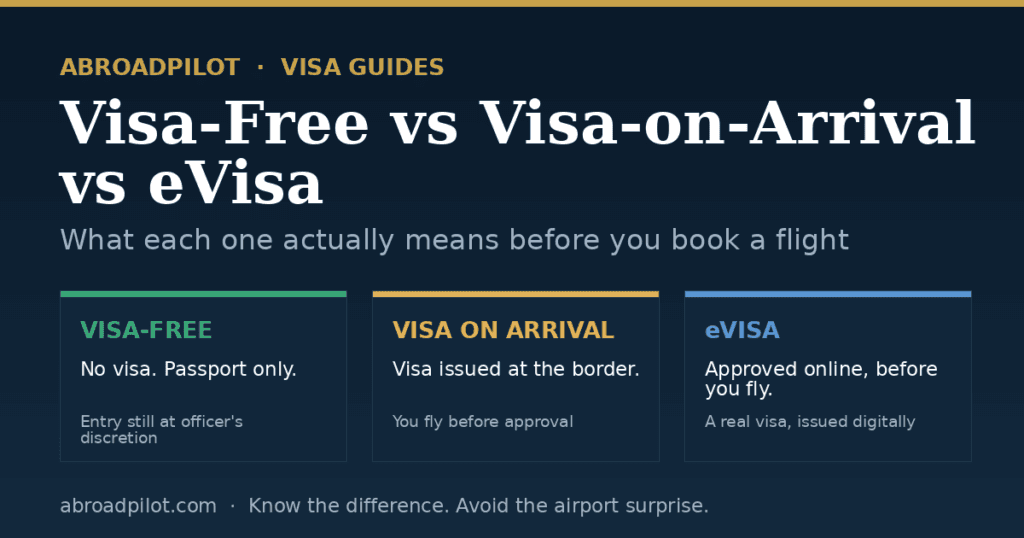
Quick summary: These three terms get used as if they mean the same thing. They do not. Visa-free means you show up with your passport and nothing else. Visa-on-arrival means you get a real visa — but only after you land, which means you fly before anyone has approved you. An eVisa is a genuine visa, applied for and approved online before you board. This is not paperwork trivia. The difference decides whether you can board your flight at all, and where in the world you are standing if something goes wrong.
Why This Confusion Costs People Money
A passport index says “visa-free or visa-on-arrival: 46 countries” and travelers read that as one category. Airlines do not read it that way. Immigration officers do not read it that way. And the traveler who booked a non-refundable ticket to a visa-on-arrival country, arrived without an onward ticket, and was refused at the border certainly does not read it that way.
The most useful mental model is a single question: where is the decision made, and when? That one question separates all three.
- Visa-free — there is no visa decision at all. Only an entry decision, at the border.
- Visa-on-arrival — the visa decision is made after you have already flown.
- eVisa — the visa decision is made before you fly, online.
Everything else follows from that.
Visa-Free: No Visa, But Not “No Rules”
Visa-free means your passport alone is your permission to travel. You do not apply for anything, you pay no visa fee, and there is no application that can be refused.
What visa-free does not mean is unrestricted entry. This is the part that catches people. The officer at the border still has full discretion to refuse you, and you are still expected to satisfy the basic entry conditions:
- A passport with enough validity remaining — usually six months beyond your stay
- A return or onward ticket
- Proof you can fund the trip
- An address where you will be staying
- A stay within the permitted limit — often 30, 60 or 90 days, and it varies by your nationality, not just by the destination
Visa-free access also comes with a hard ceiling on what you are allowed to do. It is almost always for tourism, family visits, and short business meetings. It is not permission to work, to enrol in a long study programme, or to settle. Doing paid work on a visa-free entry is a status violation — and it is exactly the kind of thing that surfaces in your next application, years later.
The trap: visa-free is the entry type most likely to make travelers complacent. No application means no paper trail, so people arrive carrying nothing — no hotel booking, no return flight, no bank statement — and are genuinely surprised when an officer asks for all three. Carry the documents even when nobody made you apply for anything.
Visa-on-Arrival: A Real Visa, Issued After You Land
Visa-on-arrival (VOA) is a genuine visa. It is simply issued at the border instead of at an embassy. You land, you join the VOA queue, you complete a form, you pay a fee, and — assuming everything is in order — you are issued the visa and you walk through.
The convenience is real: no embassy appointment, no advance processing window, no waiting for a decision before you can book. But there is an asymmetry here that very few people think through before they pay for the ticket.
With visa-on-arrival, you have already bought the flight and you are already standing in the destination country before anyone has approved your visa. If you are refused, you are refused at the far end — not at home.
A VOA is not a guarantee. It can be denied, and it is routinely denied for boring, avoidable reasons: no return ticket, insufficient funds, an unclear address, a fee that had to be paid in exact cash in a specific currency, or a passport with less than six months of validity. Some countries also restrict VOA to specific airports and land borders — arriving at the wrong crossing can void your eligibility outright.
There is a quieter risk too. Airlines carry legal liability for passengers who are refused entry, so check-in staff sometimes refuse to board VOA travelers who cannot produce a return ticket or proof of funds. You can be stopped before you ever leave home, by an airline agent, on a route where you were technically eligible.
How to Fly Visa-on-Arrival Without Getting Burned
- Carry the fee in cash, in the exact currency demanded, in usable denominations. Card machines fail. “There will be an ATM inside” is not a plan.
- Print the return ticket, the hotel booking, and the bank statement. All three. On paper.
- Confirm your entry point. Many VOA schemes only operate at listed airports.
- Bring passport photographs if the scheme asks for them.
- Re-check the fee and the eligibility list within a week of flying. These change without notice — and they change most often for exactly the passports that can least afford the surprise.
eVisa: The Same Visa, Applied For Online
An eVisa is a real visa — legally identical in force to the sticker that used to be glued into your passport. The difference is administrative: instead of surrendering your passport to a consulate, you apply online, upload your documents, pay the fee, and receive an approval linked electronically to your passport number.
The decision happens before you fly. That is the whole point, and it is the whole advantage. If you are refused, you find out while you are still at home, having lost only the application fee — not a flight, not a hotel, not a week of annual leave.
What to expect from a typical eVisa:
- You apply in advance — anywhere from 72 hours to several weeks depending on the country. It is not an airport formality.
- You will need documents — passport scan, photograph, itinerary, and sometimes proof of funds or accommodation.
- It can be refused — and unlike a VOA refusal, this one goes on record before you travel.
- Print it, or keep it offline. “It is in my email” stops being true the moment the airport wifi does.
- It is tied to the passport you applied with. Renew that passport afterwards and the eVisa dies with it.
- It has an entry window — a date range within which you must arrive. That is not the same thing as how long you are allowed to stay.
The scam warning that matters: eVisas are the most impersonated document in travel. Search almost any country’s eVisa and the top results are frequently agent sites charging three to five times the government fee — and occasionally outright data-harvesting operations. Reach the portal through the destination government’s own immigration domain. Never through an ad.
The One Table That Settles It
| Visa-Free | Visa-on-Arrival | eVisa | |
|---|---|---|---|
| Is it actually a visa? | No | Yes | Yes |
| When is it decided? | Never — only entry is decided, at the border | After you land | Before you fly |
| Apply in advance? | No | No | Yes — mandatory |
| Can you be refused? | Yes — entry refusal at the border | Yes — after you have already flown | Yes — while you are still at home |
| What a refusal costs you | Flight and hotel | Flight, hotel, and the VOA fee | The application fee only |
| Fee | None | Paid at the border, often cash only | Paid online |
| Risk profile | Low — but travelers under-prepare | Highest — you fly before approval | Lowest — you know before you board |
| Where it usually goes wrong | Arriving with no documents to show | Wrong currency, no return ticket, wrong airport | Applying too late; using a scam agent site |
How to Tell Which One Applies to You
The mistake almost everyone makes is starting with the destination. Start with your passport. Entry rules are a relationship between two countries, not a property of one. Thailand is visa-free for one nationality, visa-on-arrival for another, and full embassy visa for a third — on the same day, at the same airport.
The Fourth Thing Nobody Mentions: ETAs
There is a fourth category quietly reshaping travel, and it gets miscategorised constantly. An Electronic Travel Authorisation (ETA) is not a visa. It is a pre-screening step applied to travelers who already have visa-free access. You are still visa-free — you just now have to register online and pay a small fee before you board.
If you hold a passport with strong visa-free access, this is the change most likely to catch you out, because nothing about your visa status changed — only the admin did.
| Scheme | Destination | Status as of July 2026 |
|---|---|---|
| UK ETA | United Kingdom | Live. £20, valid two years, multiple entries of up to six months. Required from visa-exempt visitors; British and Irish citizens are exempt. |
| US ESTA | United States | Live. Required for Visa Waiver Programme nationals. |
| Canada eTA | Canada | Live. Required for visa-exempt air travelers. |
| Australia ETA | Australia | Live. |
| EU ETIAS | 30 European countries | Not yet live. Expected Q4 2026, with a transition period before it becomes mandatory. Fee set at €20. Anyone charging you for it today is running a scam — the portal is not open. |
Note that an ETA for one country does nothing for another. A Canadian eTA does not help you enter Europe. A UK ETA does not cover the Schengen Area. They are separate systems that happen to look identical.
The Rules That Apply No Matter Which One You Have
Whatever category you fall into, these do not change:
- None of them guarantee entry. Not a visa, not an eVisa, not visa-free status. The officer at the border makes the final call, every time. A visa is permission to travel to the border — not permission to cross it.
- Your nationality determines your category, not the destination. Check the rules for your passport specifically.
- Verify on the government’s own website, within days of flying. Not a blog. Not an agent. Not this article. Rules for African, South Asian, and Southeast Asian passport holders change more frequently and with less notice than for anyone else — and are the least likely to be updated accurately by third-party sites.
- The stay limit is not the visa validity. A one-year eVisa may only permit 30 days per entry. Confusing the two is one of the most common routes to an overstay — and an overstay is one of the hardest things to explain away in a future application.
- Never pay for something that is free, and never overpay for something that is cheap. If a site is charging a “service fee” on top of a government fee, you are on the wrong site.
The Bottom Line
If you take away one sentence, take this one: visa-free means no decision, visa-on-arrival means the decision comes after you have flown, and an eVisa means the decision comes before you board.
Ranked by how much a refusal will actually cost you, the order is unambiguous. An eVisa refusal costs you an application fee. A visa-free refusal costs you a flight. A visa-on-arrival refusal costs you a flight, a hotel, and a return trip you did not budget for — while you are standing in an airport thousands of kilometres from home, holding a boarding pass that no longer means anything.
Convenience at the booking stage is not the same thing as safety at the border. Know which one you are relying on before you pay for anything.
Not sure which category your passport falls into for a given country? Use the AbroadPilot Visa-Free Checker to see where your passport stands, then confirm on the destination government’s official immigration site before you book.

Olami is the founder and lead writer at AbroadPilot. He started the site after going through the visa process himself — a German student visa in 2019 and a Canadian work permit in 2023 — and learning first-hand how confusing official immigration language can be, how often rules change, and how easy it is to lose money to bad advice. He spent three years as an international education and travel consultant, helping people source and verify the information that landed their visas and planned their trips. Every guide on AbroadPilot is built from official sources — embassy pages, government immigration portals, and .gov fee schedules — and reviewed as requirements change. AbroadPilot does not sell visas or applications; it is a free resource to help readers apply with confidence.